
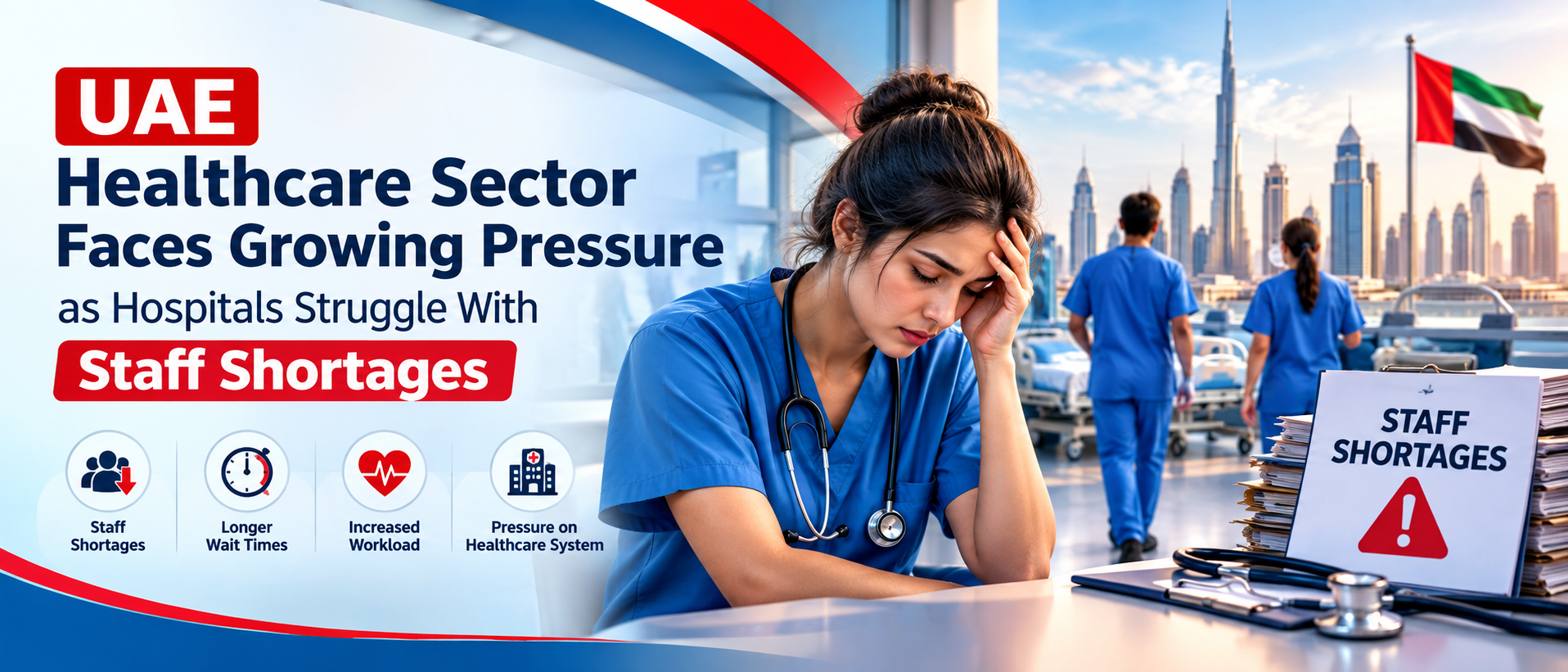

The UAE healthcare sector has developed into one of the region’s most advanced healthcare markets, supported by significant public investment, private-sector participation, modern hospitals, specialist medical centres and growing healthcare infrastructure. The UAE government describes healthcare as an important service sector and has allocated substantial federal funding to healthcare, with AED 5 billion allocated in the 2024 federal budget.
At the same time, healthcare organisations must continuously ensure that hospitals, clinics and specialist facilities have enough qualified professionals to provide safe and effective patient care. This makes workforce planning, recruitment and retention increasingly important.
The discussion around the UAE healthcare staff shortage should therefore not be reduced to a single number. Staffing requirements can vary between emirates, healthcare specialties, facility types and professional categories. Nevertheless, workforce planning has become a significant strategic issue, particularly for nursing and other clinical roles.
The UAE’s national nursing strategy specifically focuses on sustainable workforce management, recruitment capacity, workforce diversity, safe staffing and long-term workforce planning.
This article explores the factors influencing healthcare staffing in the UAE and why healthcare employers may increasingly look toward structured domestic and international recruitment strategies.
UAE Healthcare Sector and Its Growing Workforce Requirements
The UAE healthcare sector includes government hospitals, private hospitals, clinics, primary healthcare centres, specialist facilities, medical cities and other healthcare providers.
The UAE government identifies a broad network of hospitals, clinics and primary healthcare centres across the country.
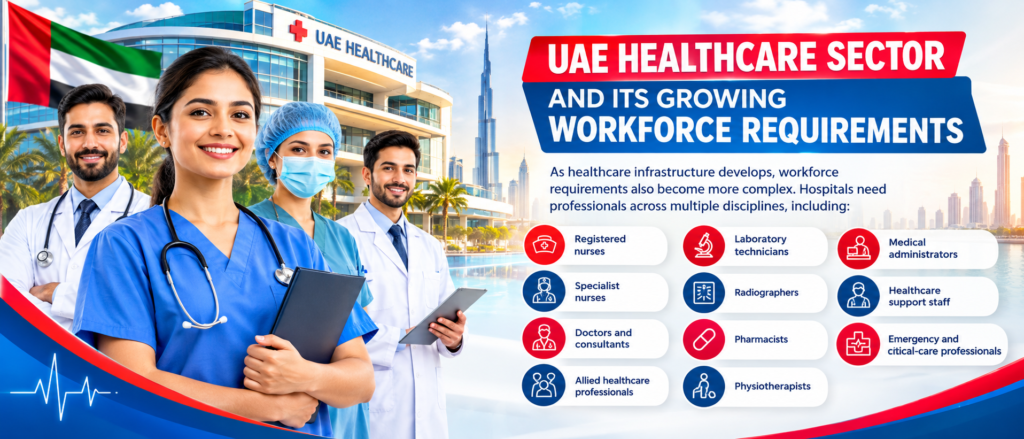
As healthcare infrastructure develops, workforce requirements also become more complex. Hospitals need professionals across multiple disciplines, including:
- Registered nurses
- Specialist nurses
- Doctors and consultants
- Allied healthcare professionals
- Laboratory technicians
- Radiographers
- Pharmacists
- Physiotherapists
- Medical administrators
- Healthcare support staff
- Emergency and critical-care professionals
The challenge is not simply recruiting more people. Healthcare employers must recruit professionals with the right qualifications, experience, licensing eligibility and specialty background.
UAE Healthcare Staff Shortage: Understanding the Workforce Challenge
The term UAE healthcare staff shortage is often used broadly to describe situations where healthcare organisations experience difficulty filling particular positions or finding professionals with specific qualifications.
A staffing gap can occur for several reasons. A hospital may have sufficient employees overall but still experience a shortage in a particular specialty, shift, department or professional category.
For example, demand may be particularly strong for professionals with experience in intensive care, emergency medicine, operating theatres, oncology, elderly care or specialised nursing.
Workforce shortages can also develop when healthcare facilities expand faster than the available pool of qualified professionals.
This makes workforce forecasting particularly important.
The UAE’s national nursing strategy includes initiatives related to workforce projection, safe staffing models and optimisation of nursing and midwifery recruitment capacity.
UAE Hospital Staff Shortage and the Importance of Workforce Planning
A UAE hospital staff shortage can create operational challenges when vacancies remain unfilled for extended periods.
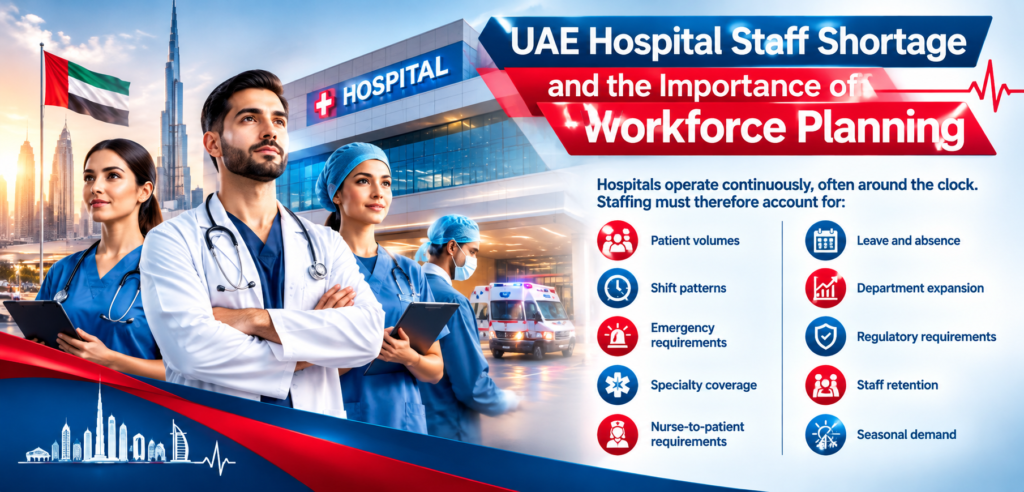
Hospitals operate continuously, often around the clock. Staffing must therefore account for:
- Patient volumes
- Shift patterns
- Emergency requirements
- Specialty coverage
- Nurse-to-patient requirements
- Leave and absence
- Department expansion
- Regulatory requirements
- Staff retention
- Seasonal demand
Workforce planning allows hospitals to identify future staffing requirements before vacancies become urgent.
The Abu Dhabi Healthcare Strategic Plan, for example, includes reducing capacity gaps and attracting, training and retaining qualified healthcare professionals among its priorities.
This demonstrates why recruitment and retention are closely connected to long-term healthcare planning.
Healthcare Staffing Shortage UAE: Why Demand Can Differ by Specialty
The healthcare staffing shortage UAE discussion must consider the fact that healthcare professionals are not interchangeable.
A hospital cannot necessarily fill a specialist nursing vacancy with any available healthcare worker. Employers may require specific qualifications, clinical experience, licensing eligibility and specialty expertise.
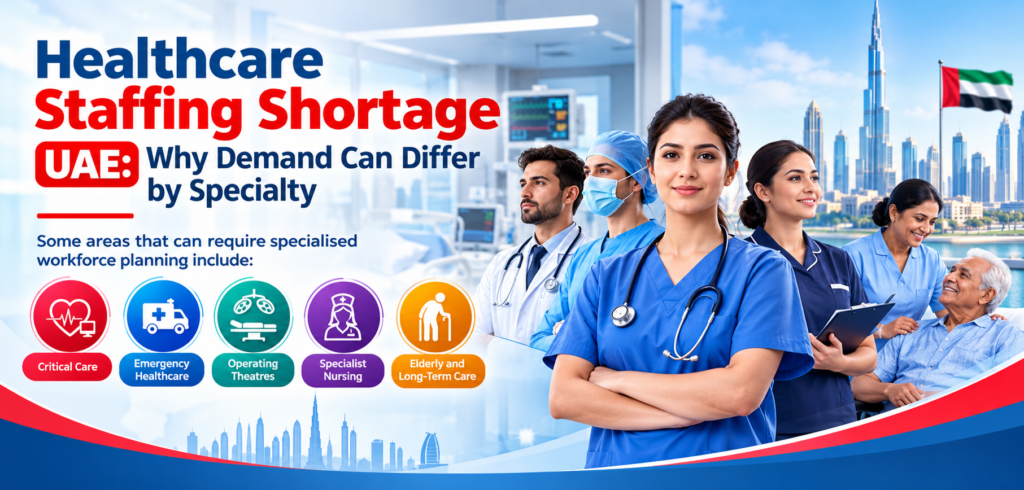
Some areas that can require specialised workforce planning include:
Critical Care
ICU and critical-care departments require professionals with appropriate clinical knowledge and experience in complex patient management.
Emergency Healthcare
Emergency departments require teams capable of responding to urgent and unpredictable patient needs.
Operating Theatres
Operating-room staffing requires professionals familiar with surgical procedures, infection-control protocols and theatre operations.
Specialist Nursing
Specialist nurses may be required in areas such as oncology, dialysis, cardiac care, paediatrics, mental health and other clinical specialties.
Elderly and Long-Term Care
Changing healthcare requirements can also increase the need for professionals working with elderly patients and people requiring long-term support.
Healthcare Workforce UAE: Building a Sustainable Talent Pipeline
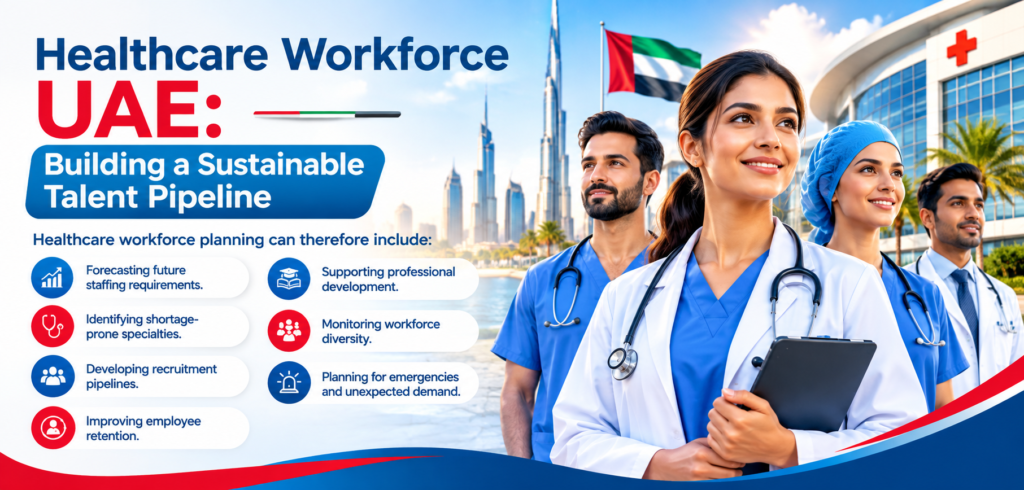
The healthcare workforce UAE requires continuous investment in education, recruitment, professional development and retention.
A sustainable healthcare workforce is not created only through short-term hiring campaigns. Healthcare organisations also need systems that encourage qualified professionals to remain within the sector.
The UAE’s national nursing strategy includes workforce management, professional development, leadership development and quality improvement as key areas.
Healthcare workforce planning can therefore include:
- Forecasting future staffing requirements.
- Identifying shortage-prone specialties.
- Developing recruitment pipelines.
- Improving employee retention.
- Supporting professional development.
- Monitoring workforce diversity.
- Planning for emergencies and unexpected demand.
Skilled Healthcare Professionals UAE: Why Qualification Matters
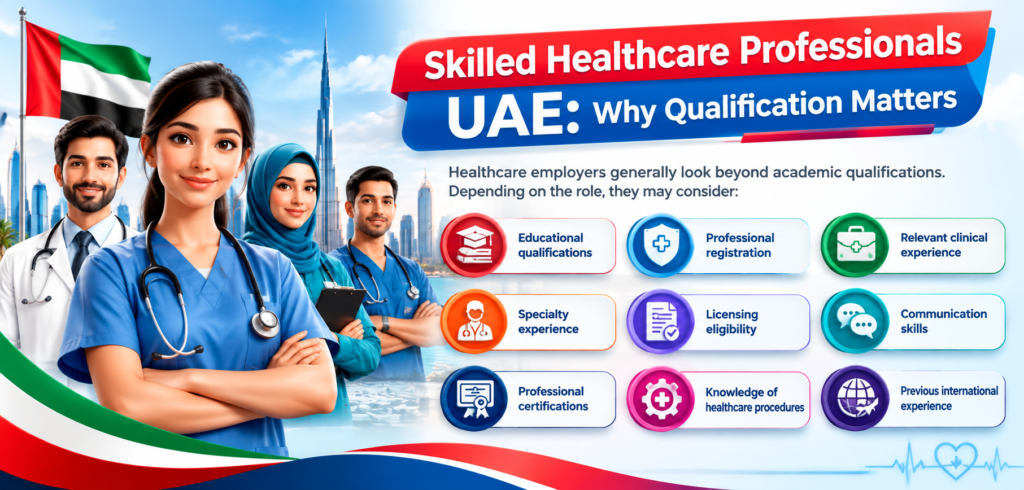
The demand for skilled healthcare professionals UAE is closely linked to the quality and complexity of modern healthcare services.
Healthcare employers generally look beyond academic qualifications. Depending on the role, they may consider:
- Educational qualifications
- Professional registration
- Relevant clinical experience
- Specialty experience
- Licensing eligibility
- Communication skills
- Professional certifications
- Knowledge of healthcare procedures
- Previous international experience
For recruitment agencies, understanding these requirements is essential before presenting candidates to healthcare employers.
A strong recruitment process should match candidates according to both qualifications and actual job requirements.
Healthcare Recruitment UAE: An Important Workforce Strategy
Healthcare recruitment UAE has become an important part of workforce planning for organisations seeking qualified professionals.
Recruitment can involve several channels, including:
- University and training-institution partnerships
- Professional networks
- Specialist healthcare recruitment agencies
- International recruitment
- Employee referrals
- Digital recruitment platforms
For specialist vacancies, international recruitment can expand the available talent pool.
However, international hiring also requires careful screening and documentation.
Employers and recruitment partners should verify qualifications, professional experience and licensing requirements before candidates proceed through the relevant recruitment process.
Hospital Recruitment UAE: From Vacancy to Placement
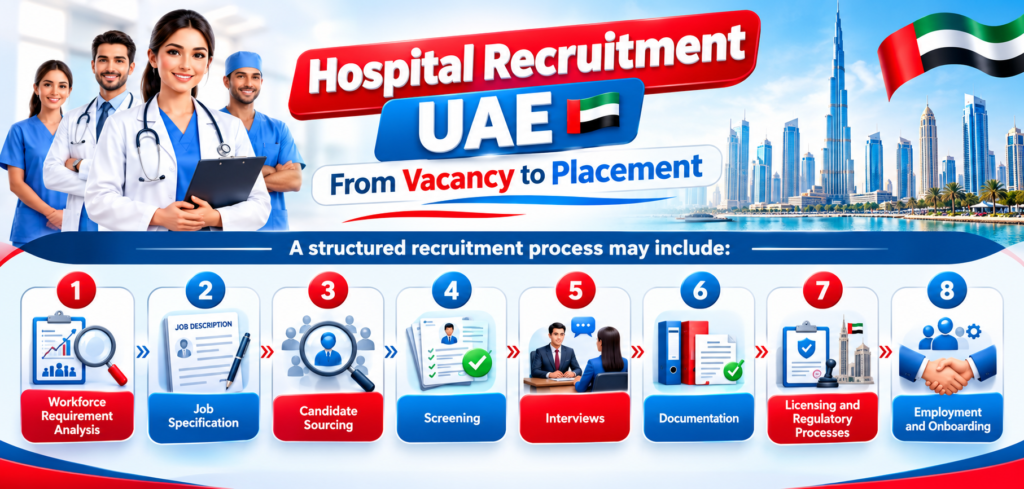
Effective hospital recruitment UAE requires more than simply advertising vacancies.
A structured recruitment process may include:
Step 1: Workforce Requirement Analysis
The hospital identifies the number of professionals required and the departments where vacancies exist.
Step 2: Job Specification
The employer defines education, experience, specialty, licensing and other requirements.
Step 3: Candidate Sourcing
Recruitment teams identify suitable candidates locally or internationally.
Step 4: Screening
Candidates are assessed against the employer’s requirements.
Step 5: Interviews
Shortlisted candidates participate in interviews or technical assessments.
Step 6: Documentation
Relevant educational, professional and identity documents are verified.
Step 7: Licensing and Regulatory Processes
Where applicable, candidates complete the required licensing and regulatory procedures.
Step 8: Employment and Onboarding
Successful candidates complete employment formalities and prepare to join the healthcare facility.
A structured process can help employers reduce unsuitable applications and improve recruitment efficiency.
Shortage of Nurses in UAE: Why Nursing Remains a Strategic Priority
The shortage of nurses in UAE is an important topic within healthcare workforce planning.
Nurses represent one of the largest professional groups within healthcare, making nursing workforce availability particularly important for hospitals and other medical facilities.
The UAE has developed a national nursing and midwifery strategy focused on sustainable workforce management, recruitment, safe staffing, professional development and workforce planning.
The strategy also recognises the importance of improving recruitment capacity and managing workforce diversity.
This indicates that nursing workforce development is not simply a short-term recruitment issue but part of broader healthcare planning.
UAE Nursing Workforce: Planning for Future Healthcare Demand
The UAE nursing workforce must adapt alongside changes in healthcare delivery.
Healthcare providers increasingly need nurses with experience in specialised areas, advanced clinical environments and patient-centred care.
Workforce planning can help healthcare organisations understand:
- Current nursing capacity
- Future staffing requirements
- Specialty-specific demand
- Recruitment timelines
- Training requirements
- Retention challenges
- Succession planning
The UAE’s national nursing roadmap includes an AI-supported workforce projection model and a safe staffing model, demonstrating the importance placed on data-driven nursing workforce planning.
Healthcare Manpower UAE: Meeting Demand Through Multiple Recruitment Channels
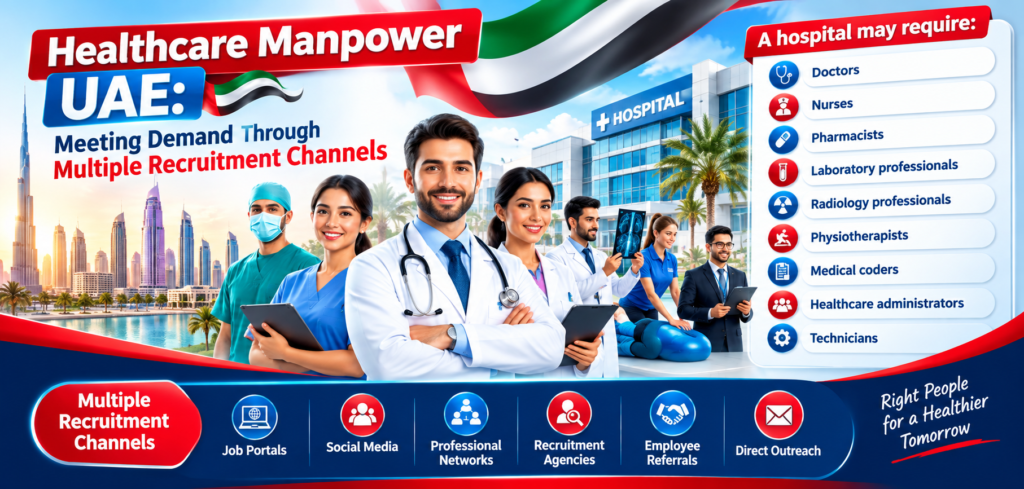
The term healthcare manpower UAE covers the broader human resources required to operate healthcare services.
This includes clinical professionals as well as technical, administrative and support teams.
Healthcare manpower planning should therefore consider the entire organisational structure.
A hospital may require:
- Doctors
- Nurses
- Pharmacists
- Laboratory professionals
- Radiology professionals
- Physiotherapists
- Medical coders
- Healthcare administrators
- Technicians
- Support staff
Each category may have different qualification and licensing requirements.
This is why healthcare manpower strategies should be based on individual job categories rather than a single overall staffing number.
Medical Staff Shortage UAE: Why Recruitment Speed Matters
A medical staff shortage UAE can become more difficult when vacancies remain open for long periods.
Healthcare facilities need recruitment processes that are both thorough and efficient.
However, speed should not replace quality.
A fast recruitment process that does not properly verify qualifications can create additional administrative and regulatory problems.
Healthcare employers should therefore aim for a balanced approach:
Fast sourcing + accurate screening + document verification + regulatory compliance + effective onboarding.
This approach can support sustainable recruitment rather than short-term vacancy filling.
Healthcare Staffing Challenges UAE: Key Issues Employers Need to Consider
The healthcare staffing challenges UAE can include several interconnected factors.
Competition for Qualified Professionals
Healthcare organisations may compete for professionals with similar qualifications and specialty experience.
Licensing Requirements
International professionals may need to satisfy relevant licensing and regulatory requirements before practising.
Retention
Recruiting a professional is only one part of workforce management. Retaining experienced employees is equally important.
Specialty-Specific Demand
Certain departments require professionals with specialised experience rather than general healthcare qualifications.
Workforce Planning
Hospitals need to forecast future requirements instead of reacting only when vacancies occur.
International Recruitment Complexity
Cross-border recruitment can involve document verification, interviews, licensing, relocation and onboarding.
UAE Hospitals Staffing Issues: Recruitment and Retention Must Work Together
UAE hospitals staffing issues cannot always be solved through recruitment alone.
If experienced professionals leave frequently, healthcare employers may need to examine retention factors alongside recruitment.
Possible workforce strategies include:
- Career development
- Professional training
- Leadership opportunities
- Clear career pathways
- Employee engagement
- Workforce planning
- Competitive employment packages
- Supportive working environments
The UAE national nursing strategy includes initiatives related to career pathways, leadership development and professional development.
These measures can complement recruitment efforts by supporting longer-term workforce sustainability.
International Healthcare Recruitment UAE: Expanding the Talent Pool
International healthcare recruitment UAE can help employers access professionals from different healthcare labour markets.
International recruitment can be particularly relevant when employers require specific combinations of qualifications, experience and specialty expertise.
Recruitment agencies supporting international healthcare hiring may assist with:
- Candidate sourcing
- CV screening
- Qualification checks
- Initial interviews
- Candidate shortlisting
- Employer coordination
- Documentation
- Recruitment scheduling
- Relocation coordination
However, international recruitment should always follow applicable UAE regulations and professional licensing requirements.
The objective should be to connect employers with appropriately qualified professionals rather than simply increasing the number of applicants.
Skilled Nurses in UAE: Supporting Hospitals With Qualified Talent
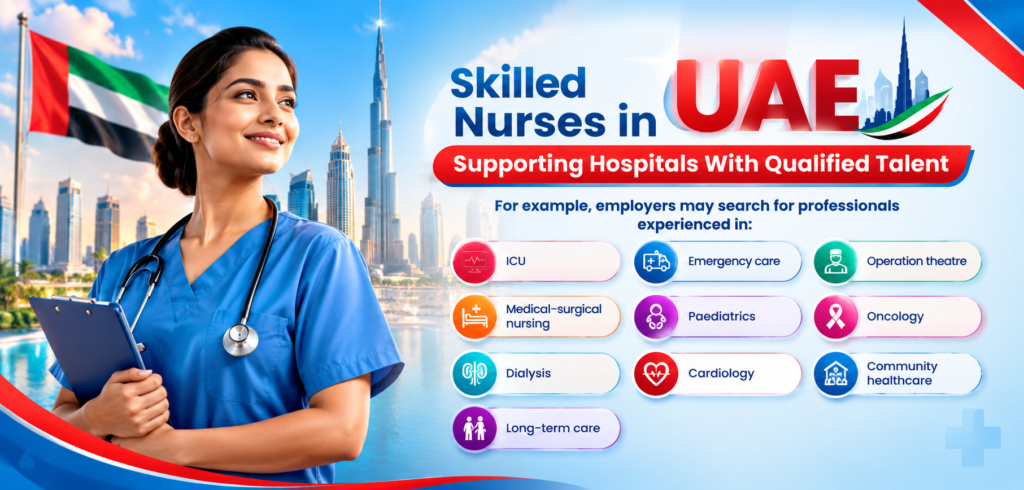
The availability of skilled nurses in UAE is closely connected to hospital capacity and patient-care requirements.
Recruitment campaigns should identify nurses according to their specific clinical backgrounds.
For example, employers may search for professionals experienced in:
- ICU
- Emergency care
- Operation theatre
- Medical-surgical nursing
- Paediatrics
- Oncology
- Dialysis
- Cardiology
- Community healthcare
- Long-term care
A targeted recruitment approach can help healthcare employers reach professionals whose experience corresponds with specific vacancies.
Healthcare Workforce Shortage: A Global Issue With Local Implications
The healthcare workforce shortage is not unique to the UAE.
The World Health Organization continues to identify global health workforce challenges, while nurses remain the largest occupational group within the health workforce. WHO’s 2025 State of the World’s Nursing report emphasises the importance of an adequately supported and equitably distributed nursing workforce.
Global competition for healthcare professionals means countries and healthcare systems need effective strategies to attract and retain qualified workers.
For the UAE, this makes workforce planning and responsible international recruitment increasingly relevant.
UAE Healthcare Recruitment Challenges: What Employers Can Do
The UAE healthcare recruitment challenges can be addressed through a combination of workforce planning, technology, recruitment partnerships and retention strategies.
Healthcare employers can consider:
Develop Long-Term Recruitment Plans
Instead of recruiting only when vacancies arise, employers can maintain talent pipelines for frequently required positions.
Build International Talent Networks
Employers can work with experienced recruitment partners to identify qualified professionals in international markets.
Strengthen Candidate Screening
Recruitment teams should verify qualifications, experience and relevant documentation before presenting candidates.
Use Workforce Data
Data can help identify departments where staffing requirements are likely to increase.
Improve Retention
Keeping experienced professionals can reduce the pressure created by repeated vacancies.
Healthcare Talent Shortage UAE: The Role of Strategic Recruitment Partners
The healthcare talent shortage UAE conversation highlights the importance of strategic recruitment partnerships.
A specialist recruitment agency in UAE can potentially support employers by maintaining candidate databases, conducting initial screening and coordinating recruitment campaigns.
For international hiring, recruitment partners can also help employers connect with professionals in countries where suitable healthcare talent is available.
However, recruitment agencies should operate transparently and ensure that candidate selection is based on legitimate employer requirements.
UAE Medical Workforce Demand: Preparing for the Future
UAE medical workforce demand is influenced by healthcare infrastructure, population needs, medical technology, specialist services and healthcare investment.
The UAE government has continued to position healthcare as an important part of national development, while healthcare strategies emphasise capacity, quality and the attraction and retention of qualified professionals.
This means workforce planning will remain an important consideration for healthcare organisations.
Future recruitment strategies are likely to place greater emphasis on:
- Specialised skills
- Workforce forecasting
- Digital recruitment
- International talent sourcing
- Professional licensing
- Employee retention
- Continuous professional development
How International Recruitment Can Support UAE Healthcare Employers
International recruitment can become one component of a broader workforce strategy when local talent availability does not fully meet a particular employer’s requirements.
A responsible international recruitment model should include:
Employer requirement → Candidate sourcing → Qualification screening → Interview → Document verification → Licensing process → Employment formalities → Relocation → Onboarding
This structured approach can help reduce recruitment risks while creating a clearer experience for employers and candidates.
For healthcare employers, the priority should remain appropriately qualified professionals who can meet the clinical and regulatory requirements of the position.
Building a Stronger UAE Healthcare Workforce
The UAE healthcare sector continues to operate within a highly developed and expanding healthcare environment. As hospitals, clinics and specialist facilities evolve, maintaining an adequate supply of qualified healthcare professionals remains an important workforce-planning priority.
The UAE healthcare staff shortage, UAE hospital staff shortage, healthcare staffing shortage UAE and broader healthcare workforce shortage discussions should be understood in terms of specific specialties, locations, facilities and professional categories rather than assuming one uniform shortage across the entire country.
The UAE’s national nursing strategy demonstrates the importance of workforce projection, safe staffing, recruitment capacity and professional development.
For healthcare employers, the response can include better workforce forecasting, stronger retention programmes, targeted healthcare recruitment UAE, specialist hospital recruitment UAE, and carefully managed international healthcare recruitment UAE.
As healthcare services become more specialised, access to skilled healthcare professionals UAE, skilled nurses in UAE and other qualified medical workers will remain an important part of healthcare workforce planning.
For hospitals and healthcare organisations, the long-term objective is not simply to fill vacancies. It is to develop a reliable, qualified and sustainable workforce capable of supporting high-quality healthcare delivery in the UAE.
Leave a Reply