


Germany’s healthcare sector continues to face strong demand for qualified nursing professionals. An ageing population, increasing healthcare needs and workforce shortages have made international recruitment an important strategy for hospitals, nursing homes, rehabilitation centres and other healthcare organisations.
For German healthcare employers, recruiting internationally can provide access to experienced professionals who are already familiar with multicultural healthcare environments. The UAE can be an interesting recruitment market because nurses working there may come from diverse professional backgrounds and may already have experience working in internationally oriented hospitals and healthcare facilities.
However, recruiting nurses from UAE to Germany requires more than simply identifying candidates and arranging interviews. Employers must consider professional qualification recognition, German language proficiency, licensing, employment contracts, immigration requirements, documentation and integration.
Germany officially treats nursing as a regulated profession. International nurses generally need recognition of their professional qualification and a state licence to practise. For nurses from countries outside the EU/EFTA, such as the UAE, individual recognition procedures apply.
This guide explains how German employers can build an effective recruitment pathway for qualified nurses currently working in the UAE.
German Healthcare Nurse Recruitment: Why Recruit Nurses from the UAE?

German healthcare nurse recruitment can extend beyond traditional recruitment markets. Healthcare employers can consider qualified nurses already working in the UAE as part of a broader international talent strategy.
The UAE healthcare market attracts professionals from many countries, creating a potentially diverse pool of nurses with experience in hospitals, clinics, long-term care, emergency care and specialised departments.
For German employers, the potential advantages include:
- Access to internationally experienced healthcare professionals
- Exposure to multicultural working environments
- Candidates with experience communicating with patients from different backgrounds
- Potential access to nurses with specialised clinical experience
- A broader international recruitment pool
- Greater flexibility when domestic recruitment does not meet workforce requirements
However, employers should assess every candidate individually. Working in the UAE does not automatically mean that a nurse’s qualification will be recognised in Germany.
The important question is not simply where the nurse currently works. German authorities assess the professional qualification and its comparability with the relevant German reference profession.
Recruiting Nurses from UAE to Germany: Understanding the Recruitment Process
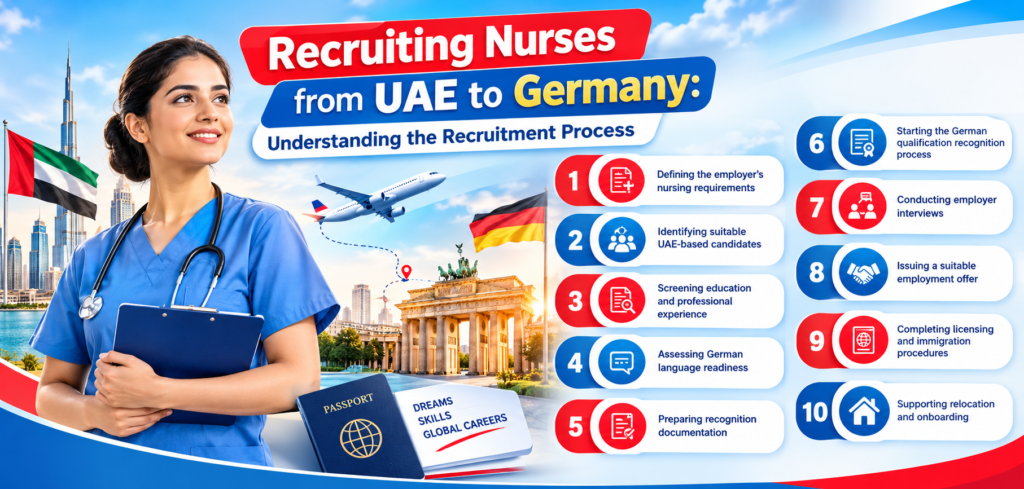
Recruiting nurses from UAE to Germany generally requires coordination between the employer, candidate, recognition authorities and, where applicable, recruitment or immigration partners.
A practical recruitment pathway can include:
- Defining the employer’s nursing requirements
- Identifying suitable UAE-based candidates
- Screening education and professional experience
- Assessing German language readiness
- Preparing recognition documentation
- Starting the German qualification recognition process
- Conducting employer interviews
- Issuing a suitable employment offer
- Completing licensing and immigration procedures
- Supporting relocation and onboarding
Because nursing is a regulated profession in Germany, professional recognition and permission to practise are central parts of the process.
Employers should therefore avoid treating international recruitment like ordinary CV sourcing. A structured compliance-first approach can reduce delays and improve candidate quality.
Qualified Nurses from UAE: What Should German Employers Look For?

When evaluating qualified nurses from UAE, employers should look beyond the candidate’s current job title.
A strong recruitment assessment can examine:
- Nursing education
- Professional registration
- Clinical experience
- Current healthcare employer
- Specialisation
- Hospital or clinical setting
- Years of professional experience
- Patient-care responsibilities
- Documentation
- Language skills
- Professional references
- Readiness for German qualification recognition
Experience in the UAE can be valuable, but it does not replace Germany’s formal recognition process.
The German authorities compare the foreign professional qualification with the relevant German reference occupation. If substantial differences are identified, a candidate may need an appropriate compensation or adaptation measure before receiving full recognition.
This makes early document screening extremely important.
Germany Nurse Recruitment Requirements for UAE-Based Candidates

Understanding Germany nurse recruitment requirements before beginning a recruitment campaign can help healthcare employers avoid unsuitable applications.
For internationally trained nursing professionals, the major areas to consider include:
Professional Qualification Recognition
The candidate’s foreign nursing qualification must be assessed for recognition in Germany.
For third-country nurses, Germany provides an individual recognition process. The competent authority in the federal state where the person intends to work examines the qualification against the relevant German reference profession.
German Language Skills
German language proficiency is another important requirement.
For recognition and professional practice as a nursing professional, the official guidance generally specifies German at B2 level under the Common European Framework of Reference for Languages (CEFR).
Employers should therefore incorporate language preparation into their international recruitment strategy rather than waiting until the final relocation stage.
Health and Personal Suitability
Candidates generally need evidence of medical fitness and trustworthiness.
This can involve medical certification and a certificate of good conduct or equivalent evidence, depending on the applicable procedure and authority.
Employment Offer
For the qualified-professional route, the candidate needs a concrete employment offer from a German employer, alongside the required professional recognition and licence conditions.
UAE Nurses for German Hospitals: How to Build a Candidate Pipeline

UAE nurses for German hospitals can be sourced through several channels.
German healthcare employers can build relationships with:
- Healthcare staffing specialists
- Professional nursing networks
- International job platforms
- Healthcare recruitment events
- Professional associations
- Direct employer recruitment campaigns
- Referral networks
A recruitment partner can help with candidate sourcing, preliminary screening, document collection, interview coordination and relocation support.
However, German employers should establish clear selection criteria before launching a campaign.
For example, an employer may specify:
Education: Recognised nursing qualification
Experience: Relevant clinical experience
Language: German language progression toward the required level
Documentation: Complete education and employment records
Specialisation: Depending on department requirements
Availability: Candidate’s expected relocation timeline
This makes candidate screening more efficient.
International Nurse Recruitment Germany: Why Compliance Matters

International nurse recruitment Germany requires careful attention to German employment and immigration rules.
A common mistake is to focus entirely on recruitment while overlooking recognition and licensing.
Because nursing is regulated, a foreign nurse cannot simply begin working as a fully qualified nurse in Germany solely because they have nursing experience abroad. Recognition and professional authorisation are important requirements.
Employers should therefore create a recruitment checklist covering:
- Qualification
- Recognition status
- Language level
- Professional experience
- Professional registration
- Medical fitness
- Good-conduct documentation
- Employment contract
- Visa/residence pathway
- Relocation requirements
This compliance-focused approach can reduce recruitment risks.
Nurse Hiring from UAE: Screening Candidates Before Interviews
Nurse hiring from UAE becomes more efficient when employers introduce pre-interview screening.
Before arranging final interviews, employers can request a structured candidate profile containing:
- Full professional CV
- Nursing qualification
- Academic transcripts where relevant
- Professional experience
- Current UAE employer
- Clinical department
- Professional registration information
- Language certificates
- Passport information where required for the process
- References
- Recognition status, if already initiated
Recruitment teams should verify information rather than relying only on CV claims.
For healthcare positions, employers can also conduct structured interviews covering clinical judgement, patient safety, communication, teamwork and practical scenarios.
The objective should be to identify candidates who are professionally suitable and capable of completing the German recognition and immigration pathway.
Germany Nursing Jobs for UAE Nurses: Matching Candidates to Employers
Germany nursing jobs for UAE nurses should be matched according to professional experience rather than simply filling vacancies.
For example, candidates with experience in:
- General hospital nursing
- Intensive care
- Emergency care
- Surgical nursing
- Geriatric care
- Rehabilitation
- Paediatric care
- Medical-surgical nursing
may have different suitability depending on the employer’s needs.
German healthcare employers should clearly explain the workplace, department, shift structure, responsibilities, employment conditions and expected language level.
A detailed job description can also help candidates understand whether the opportunity matches their experience.
Official guidance recommends that employers describe the future occupation and field of employment clearly and precisely in the employment contract.
UAE Nursing Qualifications Germany: Understanding Recognition
One of the most important subjects for employers is UAE nursing qualifications Germany recognition.
A nurse’s qualification is assessed by the competent German authority against the corresponding German reference profession.
The recognition procedure can result in different outcomes. If the qualification is considered equivalent, the candidate can proceed toward the remaining professional requirements. If substantial differences are identified, the candidate may need a compensation or adaptation measure.
Employers should therefore avoid promising automatic recognition.
Instead, candidates should be informed that recognition is an official assessment carried out by the competent authority.
The recognition process generally involves submitting the necessary documents and allowing the authority to compare the candidate’s training with German requirements. The official guidance states that the assessment generally takes around three to four months once the required documents have been submitted, although actual timelines can vary depending on circumstances.
German Nursing License Recognition: What Employers Need to Know
German nursing license recognition is essential because nursing is a regulated profession.
A candidate needs more than a nursing diploma to work as a fully qualified nurse in Germany. The professional qualification must be recognised and the required state authorisation to practise must be obtained.
According to official German guidance, professional practice generally requires:
- Recognised nursing qualification
- German language skills at the required level
- Medical fitness
- Proof of trustworthiness/good conduct
The recognition granted by the competent authority in the relevant German federal state is valid throughout Germany.
For employers, this means recognition should be integrated into recruitment planning from the beginning.
Foreign Nurse Qualification Recognition Germany: What Happens if There Are Differences?
Foreign nurse qualification recognition Germany procedures may identify substantial differences between an international qualification and the German reference qualification.
This does not necessarily mean the candidate must be rejected.
Depending on the case, the candidate may be able to complete an appropriate adaptation or compensation measure.
Germany also provides residence pathways for certain candidates whose qualifications are undergoing recognition. For example, a residence title under the recognition route may allow a candidate to complete required qualification measures in Germany.
Employers can therefore consider candidates at different stages of recognition, provided the intended employment pathway complies with German law.
Skilled Healthcare Manpower Germany: Building a Long-Term Recruitment Strategy

Skilled healthcare manpower Germany recruitment should not be treated as a one-time hiring campaign.
Healthcare employers can create long-term international talent pipelines by developing relationships with recruitment partners and establishing consistent processes.
A long-term strategy may include:
Step 1: Forecast Workforce Requirements
Determine how many nurses are needed and in which departments.
Step 2: Define Candidate Profiles
Establish education, experience, specialisation and language criteria.
Step 3: Select International Markets
The UAE can be included alongside other international recruitment markets.
Step 4: Pre-Screen Candidates
Check qualifications, experience and documentation.
Step 5: Start Recognition Early
Do not wait until the final recruitment stage to investigate recognition.
Step 6: Conduct Structured Interviews
Use standardised clinical and behavioural assessment criteria.
Step 7: Prepare Employment Offers
Clearly explain duties, location and employment conditions.
Step 8: Coordinate Immigration
Select the appropriate immigration route based on the candidate’s recognition status and circumstances.
Step 9: Support Relocation
Assist candidates with practical relocation information.
Step 10: Build Retention
Continue support after arrival and onboarding.
This approach can transform international recruitment from a reactive vacancy-filling exercise into a sustainable workforce strategy.
Overseas Nurse Recruitment Germany: The Role of Recruitment Partners
Overseas nurse recruitment Germany can involve considerable administrative coordination.
A specialist recruitment partner can support employers by helping with:
- Candidate sourcing
- Initial screening
- CV evaluation
- Interview coordination
- Document collection
- Recognition process coordination
- Language training coordination
- Candidate communication
- Relocation preparation
- Post-arrival support
However, employers should select recruitment partners carefully.
A reliable partner should understand both the source-country recruitment environment and German regulatory requirements.
Employers should also maintain transparency with candidates about job responsibilities, contractual conditions, recruitment costs and expected timelines.
Healthcare Workforce Recruitment Germany: Supporting Candidate Integration
Healthcare workforce recruitment Germany should continue beyond the visa stage.
International nurses may need support adapting to:
- German workplace culture
- Clinical documentation procedures
- Communication styles
- Shift systems
- Patient expectations
- Healthcare regulations
- Workplace terminology
- Everyday life in Germany
Language training is particularly important.
Even when candidates have strong clinical experience, working effectively with German-speaking patients and healthcare teams requires appropriate language proficiency.
Employers can support integration through:
- German language classes
- Workplace orientation
- Mentoring
- Buddy programmes
- Cultural orientation
- Accommodation guidance
- Administrative assistance
- Regular employee check-ins
These measures can help international employees feel more confident and supported.
How German Healthcare Employers Can Make UAE Recruitment More Efficient
German healthcare employers can improve the recruitment process by following several best practices.
Start Recognition Early
Qualification recognition can influence the candidate’s immigration and employment pathway. Starting early can reduce unnecessary delays.
Communicate Requirements Clearly
Candidates should know the required language level, documentation and professional expectations before committing to the process.
Use Structured Candidate Screening
A standard screening system makes it easier to compare applicants consistently.
Work With Experienced Recruitment Partners
A specialist partner can help coordinate candidate sourcing and administrative processes.
Offer Transparent Employment Information
Candidates should understand their position, workplace, working conditions and contractual terms.
Plan Integration Before Arrival
Relocation and onboarding should be considered part of recruitment rather than separate activities.
Why Germany Can Be an Attractive Destination for International Nurses
Germany’s demand for nursing professionals creates opportunities for international recruitment. Official German government information states that nursing professionals remain in high demand, with around 31,000 vacant positions in care facilities cited on its current nursing information page.
For healthcare employers, international recruitment can provide an additional source of qualified talent.
For UAE-based nurses, Germany may offer an opportunity to develop an international healthcare career, provided they meet the applicable recognition, language, licensing and immigration requirements.
The key is to approach recruitment realistically. International experience can strengthen a candidate’s profile, but Germany’s regulatory requirements remain essential.
A Practical Recruitment Checklist for German Healthcare Employers

Before recruiting nurses from the UAE, employers can use this checklist:
Employer preparation
- Define vacancies
- Determine required experience
- Prepare detailed job descriptions
- Establish salary and employment conditions
- Identify the appropriate federal state and recognition authority
Candidate screening
- Verify nursing qualification
- Review professional experience
- Check professional registration
- Assess language level
- Review available documentation
- Conduct professional interviews
Recognition
- Identify the competent recognition authority
- Submit the required documents
- Monitor the recognition process
- Plan adaptation or compensation measures if required
Immigration
- Determine the appropriate residence/visa route
- Prepare employment documentation
- Coordinate required applications
- Monitor the process
Integration
- Arrange language support
- Provide workplace orientation
- Assist with relocation
- Provide onboarding support
- Establish ongoing employee support
Building a Reliable Nursing Recruitment Pipeline from the UAE
German healthcare employers looking for qualified nursing professionals can consider the UAE as one potential international recruitment market. However, successful recruitment requires much more than finding experienced candidates.
Recruiting nurses from UAE to Germany should combine candidate sourcing with qualification recognition, German language preparation, professional licensing, employment compliance, immigration coordination and long-term integration.
For UAE nurses for German hospitals, the most important consideration is that their foreign qualification must go through the applicable German recognition process because nursing is a regulated profession.
A well-planned international nurse recruitment Germany strategy can help healthcare organisations access a broader talent pool while maintaining compliance with German professional and immigration requirements.
Employers can improve outcomes by starting recognition early, establishing clear candidate criteria, partnering with experienced international recruitment specialists and providing meaningful support throughout the relocation process.
Ultimately, successful healthcare workforce recruitment Germany is not simply about filling today’s vacancies. It is about building a sustainable international talent pipeline that benefits healthcare employers, nursing professionals and, most importantly, the patients and communities they serve.
Requirements and immigration procedures can change and may depend on the candidate’s qualification, recognition status, nationality, employment situation and German federal state. Employers should verify the current requirements with the competent German authorities before making recruitment or immigration decisions.
Leave a Reply