
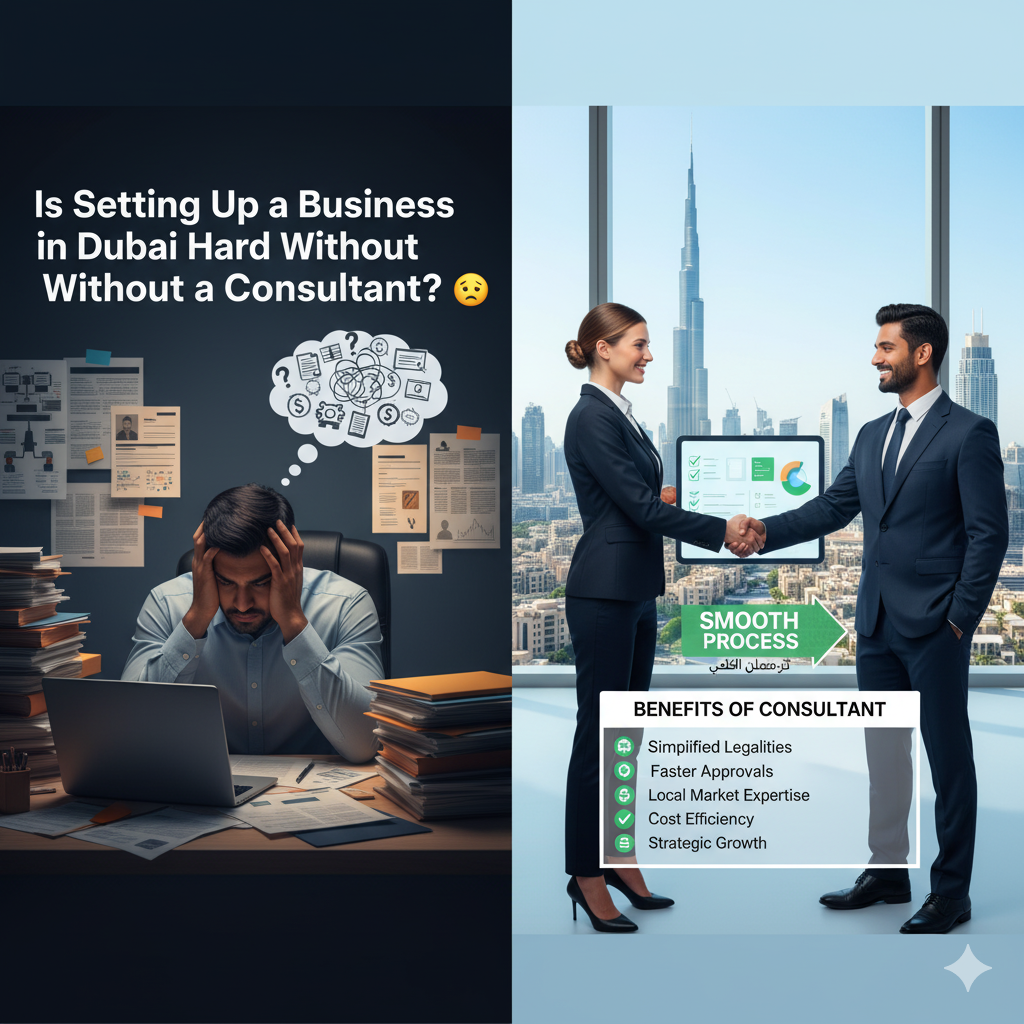
Setting up a business in Dubai has become one of the more attractive and strategic moves for entrepreneurs, small enterprises, and large firms alike—thanks to the city’s favorable tax regime, strategic location, and business-friendly infrastructure. But is it hard to do without a business setup consultant in Dubai? In this detailed blog, we’ll explore what’s involved in starting a business in Dubai, the specific services a business setup consultant provides, and how HR International UAE can help. This will give you clear insight into whether going solo is feasible or whether investing in a consultant is the smarter move.
1. Dubai’s Business Environment: An Overview
Dubai has transformed over the past few decades into a global business hub. Its strategic location between Asia, Europe, and Africa positions it as a gateway for trade, logistics, tourism, finance, and more. Some of the key features include:
- Strategic location and connectivity: With world-class airports and seaports, Dubai enables efficient global shipping and travel.
- Tax incentives and financial benefits: Many free zones offer zero corporate tax, no import or export duties, and full foreign ownership. Even in the mainland, recent reforms have made ownership easier for foreigners.
- Infrastructure and stability: Robust physical infrastructure (transport, utilities, telecommunications), political stability, strong legal framework, and ease of doing business are major draws.
- Diverse economy: From real estate to finance, tourism, retail, logistics, and tech startups—Dubai supports a wide spectrum of business types.
This environment is highly attractive but also comes with regulatory, process, and cultural nuances. Understanding them is essential before making the leap.
2. Types of Business Licenses and Legal Structures
Before you can operate, you need a license suited to your business activity. The structure you choose affects liability, ownership, costs, and regulatory oversight. Some of the common legal forms and licenses are:
- Legal Structures
-
-
- Sole proprietorship: Owned and run by one person; often relatively simple to establish but may involve more personal liability.
- Civil company: For professional services provided by individuals with certain qualifications (e.g. consultancy, medical).
- Limited Liability Company (LLC): Common for trade and services, with multiple shareholders; liability is limited to shares.
- Branch of a foreign company: For international companies wanting presence without establishing separate legal entity.
- Offshore company: For companies that don’t carry on physical operations in the UAE but use it for holding assets, international trade, etc.
-
- License Types
-
- Commercial License: For trading, importing/exporting, general business.
- Professional License: For experts, professionals, consultants, craftsmen.
- Industrial License: For manufacturing or industrial activities.
- Tourism License: For hotel, travel, tour operator businesses.
Each combination of license + legal structure has its own set of requirements and limitations (e.g. shareholding rules, physical office requirements, type of visa eligibility).
3. Free Zones vs. Mainland vs. Offshore
One of the most important decisions when setting up a business in Dubai (or the UAE generally) is where to register: Free Zone, Mainland, or Offshore. Each has its merits and limitations.
| Feature | Free Zone | Mainland | Offshore |
| Ownership | Full foreign ownership generally allowed | Recent reforms allow 100% foreign ownership in many sectors, but some restrictions remain | Full ownership, but limited to certain non-onshore operations |
| Market Access | Free zone companies often cannot trade directly in UAE mainland without a local distributor | Full access to UAE market | Not intended for doing business inside UAE; usually for international operations |
| Physical Office Requirement | Free zones often have flexi-desk or shared office options; some need physical premises | Office required in mainland; size depends on license/activity | No or minimal local presence required |
| Cost | Free zones have setup and license fees; sometimes lower overheads for warehousing, etc. | May have more regulatory cost, higher rent, local agent fees, etc. | Mainly for tax planning, asset holding, etc. |
| Visa Eligibility | Free zones offer visas tied to your business license; number depends on office type | Mainland gives more flexibility for visas, trading locally, etc. | Offshore companies generally not eligible for mainland visas |
Understanding these differences helps decide what kind of setup matches your business model and long-term goals.
4. Cost Components of Setting Up a Business
Even though Dubai is attractive, costs can add up. It’s not just the license fee. Key cost factors include:
- License registration fee: Depending on license type (commercial, professional), activity type, and jurisdiction (free zone or mainland).
- Office or premises rent: Physical office may be required. Free zones might offer co-working or flexi desks as cost-effective options. Mainland usually needs a physical premises of certain size.
- Visa costs: Employee visas, investor visas, renewal fees. Also medical testing, Emirates ID costs.
- Administrative fees and approvals: Government authority approvals, chamber of commerce, municipality, etc.
- Share capital: Some free zones or certain business types require minimum paid-up share capital.
- Local service agent or sponsor fees: If needed, especially for professional licenses or specific sectors.
- Office fit-out and utilities: Setup of workspace, furnishing, internet, electricity, etc.
- Professional services: Legal, translation, attestation, consulting fees if you use someone (like a consultant) to assist.
These costs vary heavily based on business activity, scale, jurisdiction, and whether you opt for premium or basic services.
5. Regulatory Requirements and Compliance
Dubai’s regulatory environment is robust. To stay compliant, you must understand and fulfill multiple obligations:
- Licensing and renewal: Licenses usually valid for one year; renewals require up-to-date documentation, payment of fees, possibly proof of business activity.
- Visa and immigration laws: Foreign owners/employees need visas, medical tests, Emirates ID, etc. Requirements vary with business structure.
- Labor laws: Hiring employees means complying with UAE labor laws: contracts, working hours, benefits, end-of-service gratuity, leave, health and safety.
- Commercial regulations: For specific business activities (e.g. food, health, tourism, education) there are special oversight authorities.
- Anti-money laundering (AML) / KYC: Financial and some professional businesses need to follow stringent AML / Know Your Customer procedures.
- Intellectual property, trademarks, patents: If your business relies on brand, product design, or technology, protect your IP.
- Tax compliance: While UAE has favorable tax rates, there are now VAT obligations (5%) on many goods and services; corporate tax regimes are evolving.
Failing to comply can lead to fines, suspension of license, or even business closure.
6. Role of a Business Setup Consultant in Dubai
This section explores what a consultant does, why people hire them, and what to expect.
- What is a business setup consultant?
A professional or firm that helps entrepreneurs navigate the legal, administrative, and practical steps needed to establish and run a business in Dubai.
- Key services provided:
-
-
- Advisory and planning: Helping you understand what license you need, jurisdiction, legal structure, costs, etc.
- Licensing process assistance: Submission of documents, interactions with government departments, chasing approvals.
- Office/facility search and setup: Finding suitable office space, registering the lease, configuring premises.
- Visa processing: Arranging investor/owner and employee visas, medical tests, Emirates ID, etc.
- Bank account opening: Advising on banks, helping with documentation.
- Ongoing compliance: Renewal, regulatory filings, accounting support (if offered).
-
- Advantages of using a consultant:
-
-
- Saves time: The processes can be complex and slow if you are unfamiliar.
- Avoids mistakes: Wrong license type, wrong documentation, or missing steps can cause delays or legal issues.
- Local knowledge: Consultants know local rules, updates, and best practices.
- One-stop assistance: From license to visas to bank accounts, more streamlined.
-
- Potential downsides/costs:
-
- Fees: Consultant fees add to your setup cost.
- Dependency: If consultant is handling everything, you may not fully learn the process.
- Quality variance: Not all consultants are equal; some may under-deliver or misguide.
7. How HR International UAE Supports Business Formation
While many consultants operate in Dubai, HR International UAE is one that provides a comprehensive range of services tailored to business setup. Without promoting or comparing, here is how a consultant like HR International UAE can assist:
- Tailored consultancy: They guide you toward the best jurisdiction (free zone / mainland / offshore) based on your activity, investment capacity, and market goals.
- Full licensing support: Handling paperwork, governmental applications, statistical approvals, licensing authority dealings.
- Office solutions: Helping you find and register office space whether you need a physical office or just flexi/facilities in a free zone.
- Visa and immigration processing: Managing processes for owner-investor visas, employee visas and their renewals.
- Compliance and renewal services: Reminders for license renewals, help with renewals of visas, maintaining compliance with municipal and regulatory bodies.
- Bank liaison and account opening: Guidance on which banks are suited to your business type, assisting with the documentation and processes.
- Cost structure transparency: A consultant clarifies all fees upfront, so you’re aware of license costs, government fees, service charges, etc.
Using a consultant like HR International UAE doesn’t guarantee zero complications, but it significantly improves your ability to navigate the setup process smoothly and efficiently.
8. Common Challenges and How to Overcome Them
Even with good planning and professional help, entrepreneurs frequently encounter obstacles. Anticipating these can help you avoid or mitigate them.
- License Rejections or Delays
-
-
- Causes: Wrong or incomplete documents; mismatch between business activity and license category; jurisdiction issues.
- Solution: Double-check document requirements; use a consultant for administrative coordination; allow extra time for approvals.
- Causes: Wrong or incomplete documents; mismatch between business activity and license category; jurisdiction issues.
-
- Bank Account Opening Difficulties
-
-
- Causes: Banks are cautious about money-laundering / KYC; sometimes requirement for significant deposit or capital; documentation mismatches.
- Solution: Use recommendations of consultants who have existing relationships; prepare detailed business plan; ensure all documents are correctly attested.
- Causes: Banks are cautious about money-laundering / KYC; sometimes requirement for significant deposit or capital; documentation mismatches.
-
- Visa & Immigration Delays
-
-
- Causes: Medical testing; backlogs; missing paperwork; quotas.
- Solution: Submit early; ensure all medical/identity documents are ready; use professional assistance to track status.
- Causes: Medical testing; backlogs; missing paperwork; quotas.
-
- Regulatory or Jurisdictional Changes
-
-
- Causes: Periodic updates in laws, ownership rules, free zone policies.
- Solution: Stay informed; work with consultant who tracks changes; consult legal advisors if doing something complex.
- Causes: Periodic updates in laws, ownership rules, free zone policies.
-
- Cost Overruns
-
-
- Causes: Unexpected fees; higher rent; higher costs of utilities or utilities delays; consultant’s additional fees.
- Solution: Budget contingency; get detailed cost-breakdown; negotiate where possible.
- Causes: Unexpected fees; higher rent; higher costs of utilities or utilities delays; consultant’s additional fees.
-
- Cultural and Market Understanding
-
- Causes: Business culture in UAE (contracts, negotiations, government dealings) can differ from elsewhere; consumers have certain expectations.
- Solution: Engage local partners or advisors; conduct market research; adapt to local norms; ensure contracts are clear and legal.
- Causes: Business culture in UAE (contracts, negotiations, government dealings) can differ from elsewhere; consumers have certain expectations.
9. Should You Use a Consultant or Go It Alone?
Here, weigh the decision points to help you decide what’s right for your situation.
| Factor | Doing It Yourself | Using a Consultant like HR International UAE |
| Time investment | High—you must learn the regulatory framework, documentation, interact with multiple agencies | Lower—consultant handles most of the legwork |
| Cost | Lower in direct fees but potential for mistakes, delays which can cost more | Higher upfront cost, but risk reduction and speed may save money overall |
| Control & Learning | You gain intimate understanding of the process, control | Less direct involvement, but you rely on someone else’s expertise |
| Speed | Likely slower unless you already know the system well | Much faster; consultant has established networks and knowledge |
| Risk | Higher risk of non-compliance, missing deadlines, selecting wrong license | Lower risk; more compliant, minimal surprises |
When going it alone might make sense:
- You have prior experience in UAE business or with similar regulatory environments.
- Your business model is simple (no complex licensing, no strict regulations).
- You have ample time to devote to the process.
When hiring a consultant is recommended:
- You’re unfamiliar with UAE rules/laws.
- Your business falls under regulated sectors (food, health, education, finance).
- You need to get setup quickly.
- You want to minimize legal/compliance risks.
10. Step-by-Step Business Setup Process in Dubai
Here’s a more detailed walkthrough of what you can expect from beginning to end.
- Define Your Business Activity
-
-
- Decide what exactly you will do: trading, services, industrial, professional.
- Some activities require special approvals or specific locations.
-
- Choose Legal Form & Jurisdiction
-
-
- Mainland, Free Zone, or Offshore.
- Decide license type: commercial, industrial, professional, etc.
-
- Check Name and External Approvals
-
-
- Pick a trade name. Make sure it complies with naming rules (no blasphemy, no references to gods or religions, etc.).
- Obtain any approvals needed from external bodies (e.g. health authority, municipality).
-
- Reserve Trade Name & Register the Business
-
-
- Apply for name reservation, generally with Department of Economic Development (for mainland) or relevant free zone authority.
- Submit initial documents to licensing body.
-
- Submit Required Documents
-
-
- Passport copies; visa status; shareholding details; lease agreement; NOCs if required; some professional licenses require certificates or degrees.
-
- Obtain License and Incorporation Certificate
-
-
- Once approved, license is issued. In the case of LLCs, you may also need a Memorandum of Association.
-
- Set Up Office Premises
-
-
- Secure required office space. For mainland, you may need physical space. Free zones may offer shared or flexi options.
-
- Open Bank Account
-
-
- Choose bank; submit required documents: business plan, license, shareholder IDs, etc.
-
- Visa & Immigration Formalities
-
-
- Apply for owner/investor visa; employee visas; medical tests; Emirates IDs.
-
- Compliance & Ongoing Operations
-
- Renew license yearly; file for renewal of visas; ensure accounting and audits if required; renew any additional permits.
11. Key Tips for Success in Your Dubai Business
To maximize your chances of launching successfully and sustaining your business, consider the following:
-
- Do your market research: Understand demand, competition, pricing, customer preferences in Dubai/UAE.
- Understand cultural norms and business etiquette: Business relationships in UAE often rely on trust and relationships. Be respectful, punctual, and aware of negotiation styles.
- Plan cash flow carefully: Even with favorable tax and cost structures, cash is needed for rent, salaries, visas, utilities.
- Be aware of legal and environmental standards: If you’re in sectors like food, health, tourism, environment, there are strict quality, safety, labeling, waste disposal rules.
- Adapt to changing regulations: UAE regulatory environment evolves—tax laws, ownership rules, visa rules etc. Stay informed.
- Get professional help where needed: Legal advisors, accountants, consultants. Mistakes in compliance, contracts, or licensing can be costly.
- Protect your IP and brand: Register trademarks; protect designs; ensure contracts with employees or partners have appropriate IP clauses.
- Do your market research: Understand demand, competition, pricing, customer preferences in Dubai/UAE.
- Network locally: Build relationships with local business councils, chambers of commerce, free zone authorities. These networks can offer support, insight, opportunities.
Conclusion
Setting up a business in Dubai presents many attractive advantages—tax benefits, strategic location, robust infrastructure. However, it’s not a walk in the park. There are legal frameworks, licensing, jurisdictional decisions, compliance, and cost components that must all be considered.
A business setup consultant in Dubai can alleviate many pains—helping with licensing, navigating regulatory bodies, visa processing, compliance, bank account setup, and more. Using a consultant like HR International UAE can be particularly helpful if you are new to the UAE, want speed, want to reduce risk, or are entering a regulated sector.
Whether you choose to do it all yourself or hire a consultant depends on your experience, budget, time constraints, and risk tolerance. For many, investing in expert guidance pays off, saving time, avoiding pitfalls, and letting you focus on growing the business rather than dealing with paperwork.
Leave a Reply